
WRITTEN BY: KATE MACCABE
Key insights from TRUE CONFESSIONS: AI Hype + Fundraising, hosted by Flywheel Strategy and Tech/ish during NYC Tech Week.
There’s a version of the AI market story that goes like this: Q1 2026 set new highs for venture dealmaking and exits. Capital is flowing. Investors are hungry. It’s a great time to be building in AI.
Then there’s the story most founders are actually living.
Strip out the five largest deals and exits from Q1 2026, and those record-breaking figures collapse by 73.2% and 86.6% respectively (source: NVCA & Pitchbook). The headline numbers say boom. The median founder’s experience says otherwise. Capital is pooling at the top while everyone else competes for what’s left.
The vibe and the data don’t match. And that gap is the story.
At Flywheel Strategy, we brought this tension into the open at True Confessions: AI Hype + Fundraising, a candid, facilitated session held during NY Tech Week 2026 in partnership with Tech/ish. Rather than another panel of polished talking points, we collected real, anonymous sentiment from founders across consumer and tech sectors and investors, the things people actually think but rarely say on stage or in press cycles.
Here’s what we found, and what it means for AI startup market fit, messaging strategy, and fundraising in the current environment.
The Two-Speed AI Market Nobody Talks About
The most important thing to understand about AI fundraising right now is that there isn’t one AI market. There are two.
There’s the market that gets covered: record rounds, splashy announcements, investors publicly declaring AI their primary thesis. Then there’s the market most founders are navigating: intense competition, skeptical LPs, pattern-matching investors, and a fundraising process that feels harder, not easier, despite being in the hottest sector in venture.
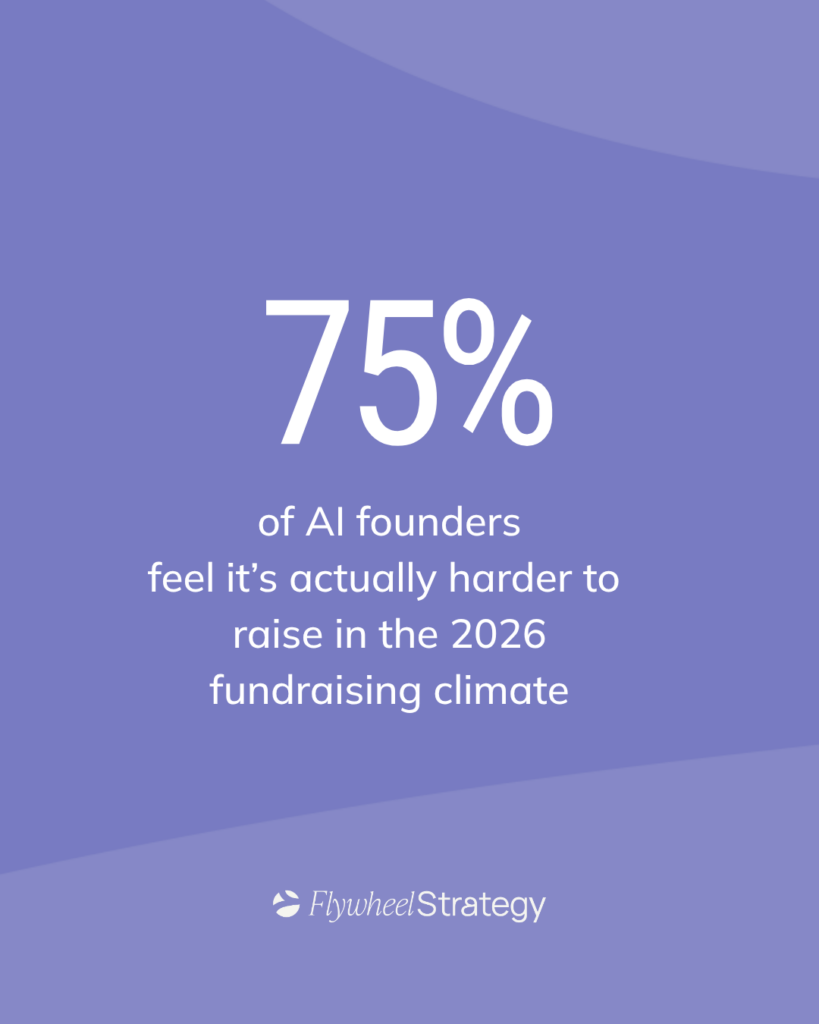
Our survey data confirmed what we suspected: 75% of AI founders say it’s actually harder to raise in the current climate — many say much harder. The AI boom is real, but it’s concentrating capital, not distributing it.
The founders who do find it easier to raise? They tend to be the same founders who communicate about AI in ways that misalign with how they actually feel about the market. Which leads directly to the messaging problem.

The Messaging Gap Is Larger Than You Think
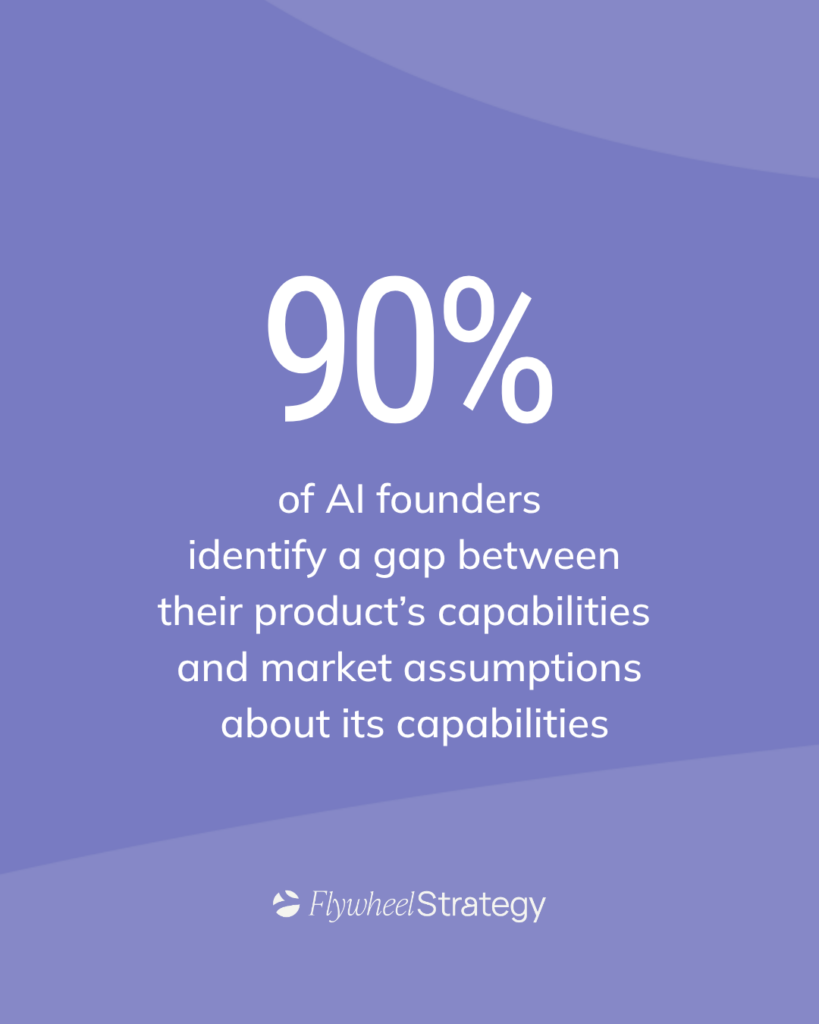
Here’s a statistic that should give every AI founder pause: 90% of AI founders in our survey identified a gap between their product’s actual capabilities and what the market assumes about those capabilities.
That gap splits roughly evenly between two types:
- The “AI” gap: results are actually achieved through smart engineering, workflow design, or human-in-the-loop, but the market (and the AI start up itself) labels it AI.
- The generalization gap: the product works well in specific, narrow cases, but market assumptions about breadth far outrun actual performance
This isn’t a product problem. It’s a messaging and positioning problem. And it’s one that affects both customer acquisition and investor confidence.
When your messaging promises what your product can’t yet deliver, you win the first impression and lose the relationship. Customers churn when reality doesn’t match expectation. Investors lose trust when the diligence process surfaces the gap. The short-term boost from AI positioning is frequently costing founders the long-term credibility they need to close rounds and retain users.
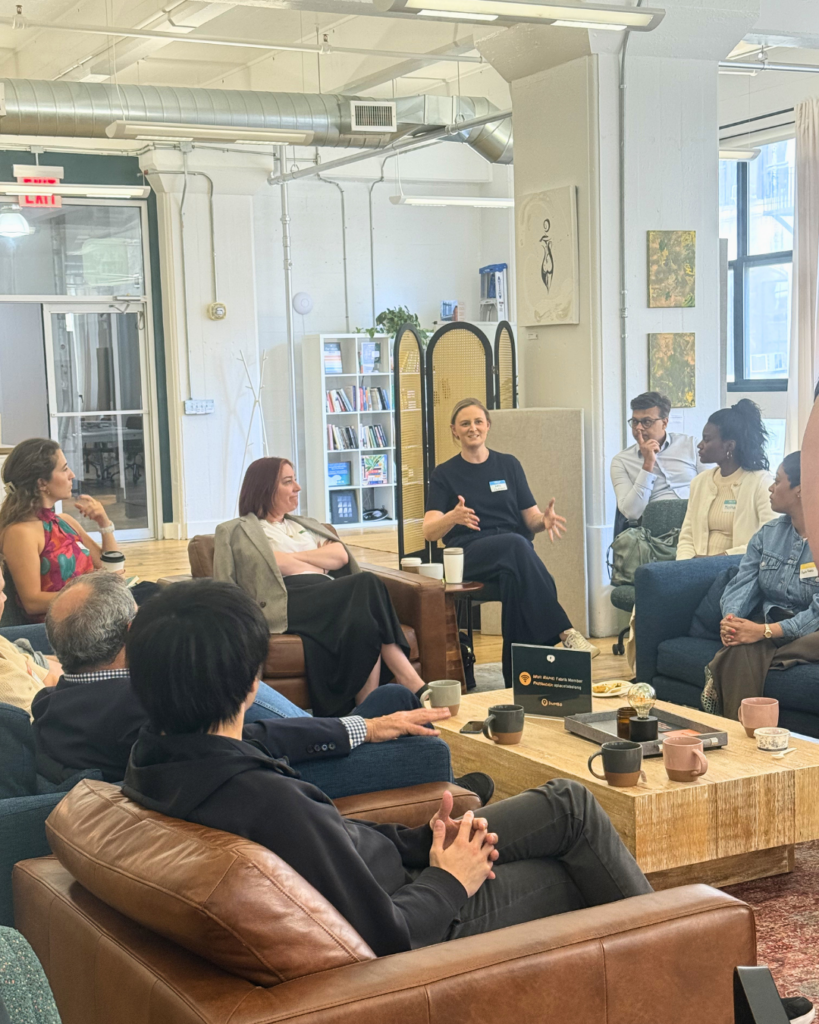
The session format — circle discussion, no stage, no panels — was designed to create a safe space for founders and investors to speak honestly about what’s actually working and what isn’t.
What the Survey Said Out Loud (And What It Didn’t)
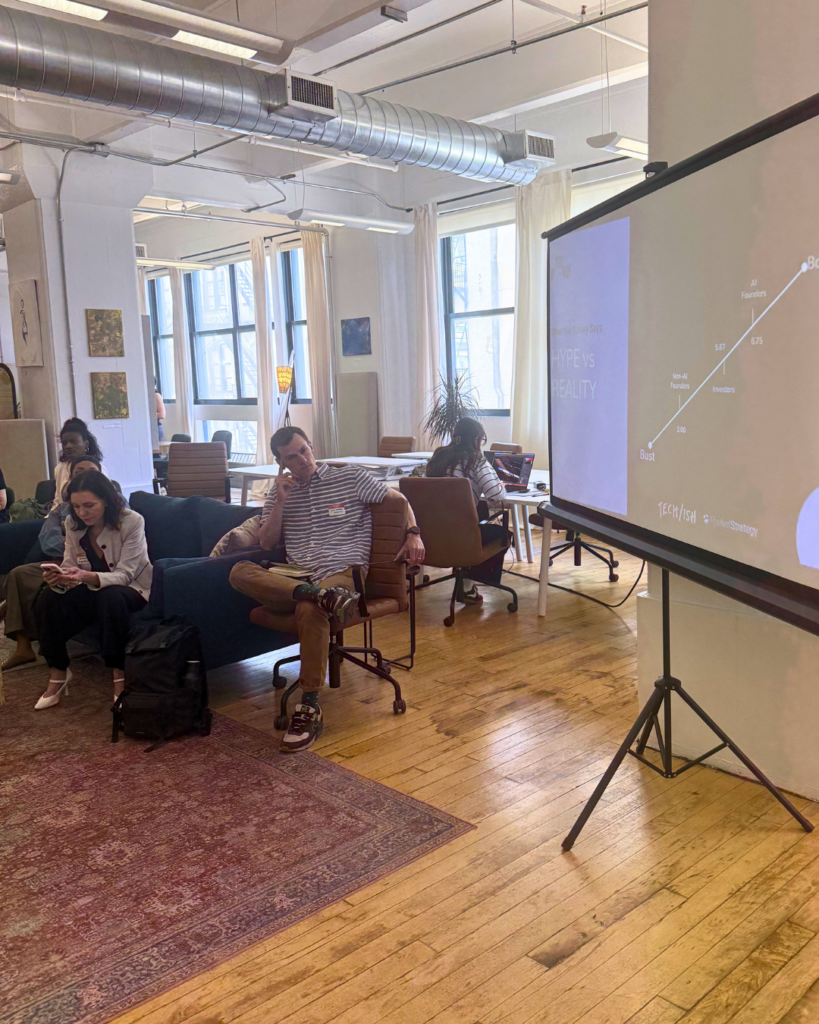
We asked attendees to rate their outlook on the AI market on a scale of 0 (bust) to 10 (boom). The results revealed a three-speed market nobody on LinkedIn is talking about:
- AI Founders: 6.75 average: cautiously optimistic, but with significant nuance underneath
- Investors: 5.67 average: measured, hedging
- Non-AI Founders: 3.00 average: experiencing the AI funding moment as a direct threat to their own access to capital
Three personas. Three completely different experiences of the same market.
The anonymous qualitative responses were even more revealing. Here’s what participants said in their own words when we asked what they won’t say out loud:
“It sometimes costs more time and money than it is worth.”
“Most people are not using it to the degree influencers appear to be using it.”
“Even though I’m excited about the opportunities, I’m a bit ashamed to be an AI founder sometimes.”
“It’s going to significantly increase productivity, but organizations are not correctly set up to handle that shift in workflows/management.”
~25% of respondents say they communicate in public with more AI optimism than they actually feel. Notably, those same respondents also tend to be the ones finding it less challenging to raise right now. The implication is uncomfortable but important: there’s a short-term incentive to perform AI optimism that may be distorting both the market signal and the founder experience.
The survey also revealed a pervasive sense of distrust that spans all three personas and the full optimism spectrum:
- Skepticism about reporting practices
- Concern about predatory investing dynamics
- Worry that AI labs are getting founders and companies “hooked” before spiking prices. Even the most optimistic respondents are seeing nuance.
What Honest AI Messaging Strategy Actually Looks Like
If 90% of founders are navigating a gap between what their product actually does and what the market assumes, the question isn’t whether to address that gap — it’s how.
The most effective AI startup messaging strategy we work with at Flywheel does three things:
1. Lead with the specific, demonstrated outcome. Not the AI mechanism. The word “AI” has become a category descriptor, not a differentiator. What differentiates you is the specificity of the problem you solve and the precision of the result you deliver. Lead with that.
2. Be honest about the scope. If your product works best in specific, narrow use cases, say so — and then explain why that scope is actually a feature, not a limitation. Investors and customers who are told the truth upfront stay longer. Those who discover a gap later don’t.
3. Shape your story before the market shapes it for you. One of the questions from our session that generated the most discussion: The market will form a story about what you’re building. Do you shape it, correct it, or ride it? Most founders are riding a story someone else started. The ones who build durable companies are the ones who shape their own narrative from the first conversation forward.
This is the intersection of AI startup messaging strategy and product-market fit for AI startups. And it’s where most of the leverage actually lives.
AI Fundraising Strategy: What Investors Are Actually Looking For
100% of investors in our survey said that partner expectations around AI exposure are now shaping which companies they consider. AI exposure is now table stakes for getting a first meeting at many firms — which creates an obvious incentive for non-AI and hybrid companies to front-load AI in their positioning.
But the investors who are actually deploying capital carefully are also the ones asking harder questions. About half of investors in our survey say they’re accelerating their process when evaluating AI opportunities — but the other half are maintaining the same rigor as before. The floor, not the ceiling, is rising.
Here’s what separates the founders getting funded from those who aren’t, based on what we heard across the session and are seeing with the consumer and tech companies we’re supporting:
Demonstrated traction with honest attribution. Not “we’re AI-powered.” Not a waitlist. Actual users with actual behavior change, and a clear-eyed explanation of what the product does and doesn’t do autonomously. Investors are increasingly asking: is the revenue really recurring? What’s the unique IP? Is the cost basis sustainable?
A moat that isn’t the model. The investors in our room were clear: they’re specifically looking for businesses that have a bigger moat and are more likely to be successful regardless of how AI grows. If your only competitive advantage is your current model performance, you don’t have a moat — you have a temporary lead that any well-funded competitor can close.
A fundraising narrative built around behavior change. The AI startup fundraising pitches that are landing right now aren’t pitching AI features. They’re pitching the specific, measurable behavior change they create in a user’s life or workflow and demonstrating that the behavior change is durable enough to generate recurring revenue.
As one attendee put it: “You have to find the recurring revenue.” That observation cuts to the heart of what separates a fundable AI business from an AI-enabled product.
Consumer AI Enablement: The Access Problem Nobody Is Solving
There’s one dimension of the AI market that our session surfaced and that we want to name explicitly, because it matters for anyone building consumer AI products and anyone investing in them.
In our survey, AI founders from non-traditional backgrounds reported feeling the same investor pattern-matching and trend-following behaviors as everyone else — and in some cases, worse. One attendee specifically called out their “direct experience” not being taken seriously because of who they are or where they’re from.
The question this raises isn’t rhetorical: Is AI opportunism helping — or worsening — the access problem in venture?
For consumer AI founders specifically, this has a direct implication for consumer AI enablement strategy. The founders best positioned to build products that reach underserved consumer segments are often the ones with the most direct lived experience of those segments. If that experience isn’t being valued in funding conversations, the market is leaving real opportunity on the table — and real communities underserved.
This is a thread Flywheel is following closely. We’ll be publishing more on the data as it develops.
Join the Next Conversation
The True Confessions format: anonymous survey data, facilitated discussion, no stage, no polished talking points; exists because the most useful conversations in the AI ecosystem aren’t happening in public. They’re happening in rooms like this one.
Whether you’re an AI founder navigating a raise, an operator building consumer-facing products that need to be AI-drive, or an investor trying to calibrate what’s real versus what’s performed, this is the conversation worth having.
Schedule time to dive into your balance between hype and reality as you accelerate growth for your business.

BE THE FIRST TO COMMENT: